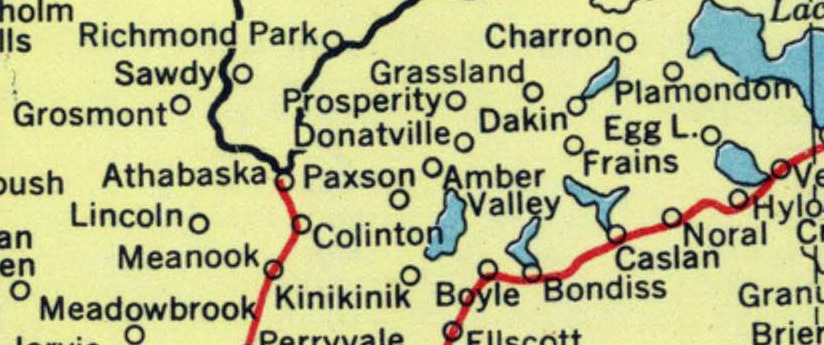
 D O N A T V I L L E
Donatville, a small hamlet in northern Alberta's Athabasca County, originated as a pioneer settlement in the early 20th century and takes its name from Donat Gingras, a prominent early settler in the region. Gingras hailed from Joliette, Quebec, and arrived in the Athabasca area at the age of eighteen, where he contributed significantly to the initial homesteading and community-building efforts amid the challenging northern frontier.
The formal establishment of the Donatville post office on August 1, 1914, solidified the community's name in recognition of Gingras's pioneering role, serving as a key marker of settlement in what was then the Athabaska electoral district. This post office operated until March 1980, facilitating communication and mail services for early homesteaders scattered across the rural landscape, including shared services with the neighboring Pine Creek settlement (later Amber Valley) prior to 1931.
During the 1910s, the Athabasca region, including areas that would become Athabasca County (established in 1913), saw a rapid influx of homesteaders under the Dominion Lands Act of 1872, which offered 160-acre quarter-sections for a nominal fee to encourage agricultural development. This era of land claims was fueled by railway expansions, such as the Canadian Northern Railway reaching Athabasca Landing in 1912, drawing diverse settlers—including French-Canadians like Gingras, Ukrainians, and others—to clear land for farming and establish isolated outposts like Donatville approximately 30 km northeast of Athabasca town.
The early settlement of Donatville emerged in the 1910s amid a broader wave of pioneer migration to northern Alberta's Athabasca region, with homesteaders of diverse backgrounds, including French-Canadians and other Europeans, establishing farms under Canada's homestead policies offering 160-acre plots for a $10 fee. The nearby Pine Creek area (later renamed Amber Valley) saw a parallel influx of African American families fleeing Jim Crow segregation, racial violence, and disenfranchisement in states like Oklahoma and Texas, attracted by opportunities in the "Last Best West." By 1910, approximately 300 such migrants had arrived in the Pine Creek area.
>