 R A V E N
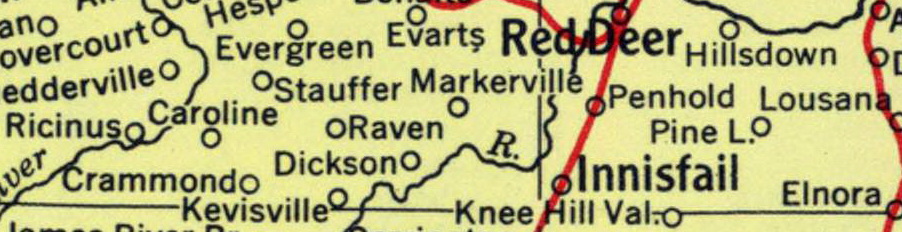
European settlement in the Raven area began with Robert Shannon arriving as the first known settler in 1894, though organized homesteading commenced in 1901 when William Berry arrived from Nebraska to scout land opportunities west of Red Deer] He was soon followed by his father, Thomas Berry, and brothers David and Harper in 1902, who filed homesteads on three quarters of Section 14, Township 36, Range 4, West of the 5th Meridian, establishing the core of the community along the Raven River. The Berry family brought essential supplies by rail and wagon, constructing a single building that served as home, storage, and initial nucleus for further arrivals, marking the onset of organized homesteading in the district.
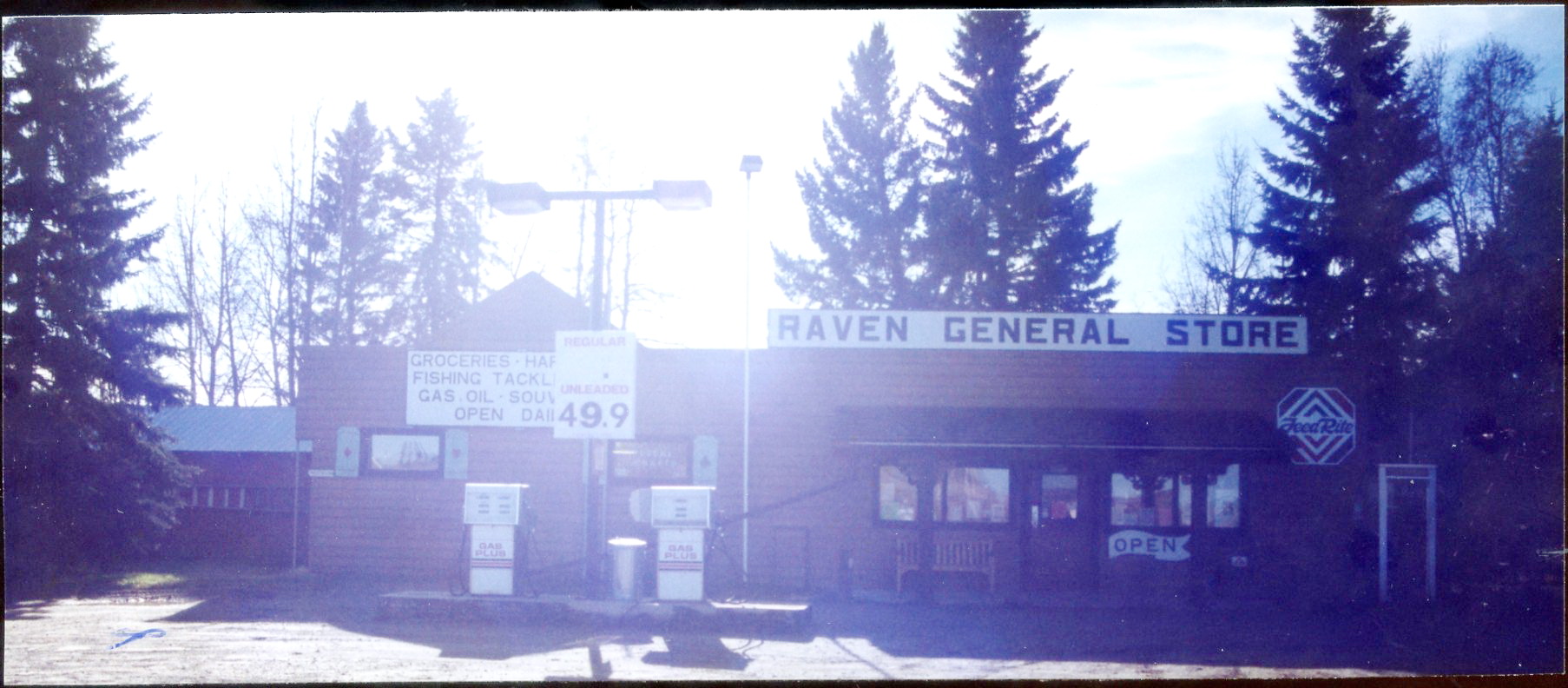
A pivotal milestone came on February 1,1905 with the establishment of the Raven post office and general store on Thomas Berry's homestead, formalizing the community's role as a crossroads hub for settlers and transient workers. Thomas Berry served as the inaugural postmaster from February 1, 1905, until November 19, 1906, operating the facility adjacent to the Raven River banks to support the influx of homesteaders drawn by Alberta's post-1905 land promotion campaigns. The store handled substantial mail and supplies for the burgeoning sawmill industry nearby, accommodating lumber camps and travelers; for instance, the Berrys once hosted 33 men and 66 horses from a railroad crew, providing meals and stabling for a nominal fee. Early infrastructure expanded with the construction of a sawmill on the Berry property in 1904, powered by the river, which bolstered local resource extraction and attracted additional families during the regional homesteading surge.
Community development accelerated in the early 20th century through educational facilities and nearby postal services. The South Fork School, the first one-room schoolhouse in the broader Caroline area encompassing Raven, was built in 1907 to serve the growing number of settler children. This was complemented by the opening of the Caroline post office in 1908, which extended administrative support and facilitated communication for Raven residents reliant on overland routes. A local Raven school was also established on David Berry's homestead (N.W. 12-36-4-W5), providing basic education until its eventual demolition. These developments reflected the homesteading boom following Alberta's 1905 provincial incorporation, with families like the Berrys expanding claims—Preston on the remaining quarter of Section 14, Harold on S.E. 10—and hosting waves of immigrants drawn to fertile prairies.
By the mid-20th century, Raven experienced population decline influenced by broader prairie trends, including post-World War II mechanized farming that reduced labor needs on homesteads. For example, Harold Berry, who had consolidated family lands, retired from farming in 1948 and relocated to Red Deer, exemplifying the shift away from small-scale operations. The community's economy transitioned from rail-dependent logging and mixed farming to highway-oriented activities, as improved roads diminished the centrality of crossroads stores like the Berry's, which changed hands multiple times—passing to the Walker family in 1920, surviving a 1929 fire, and closing permanently in 1970. This period saw the post office operate under successive postmasters, including Annie Walker (1920–1941), Norman Beale (1941–1951), and Marjorie Jean Jensen (1968–1970), before mail delivery shifted to a rural route from Innisfail.
early 1990s